Field Notes
The Case of the Bigger Room
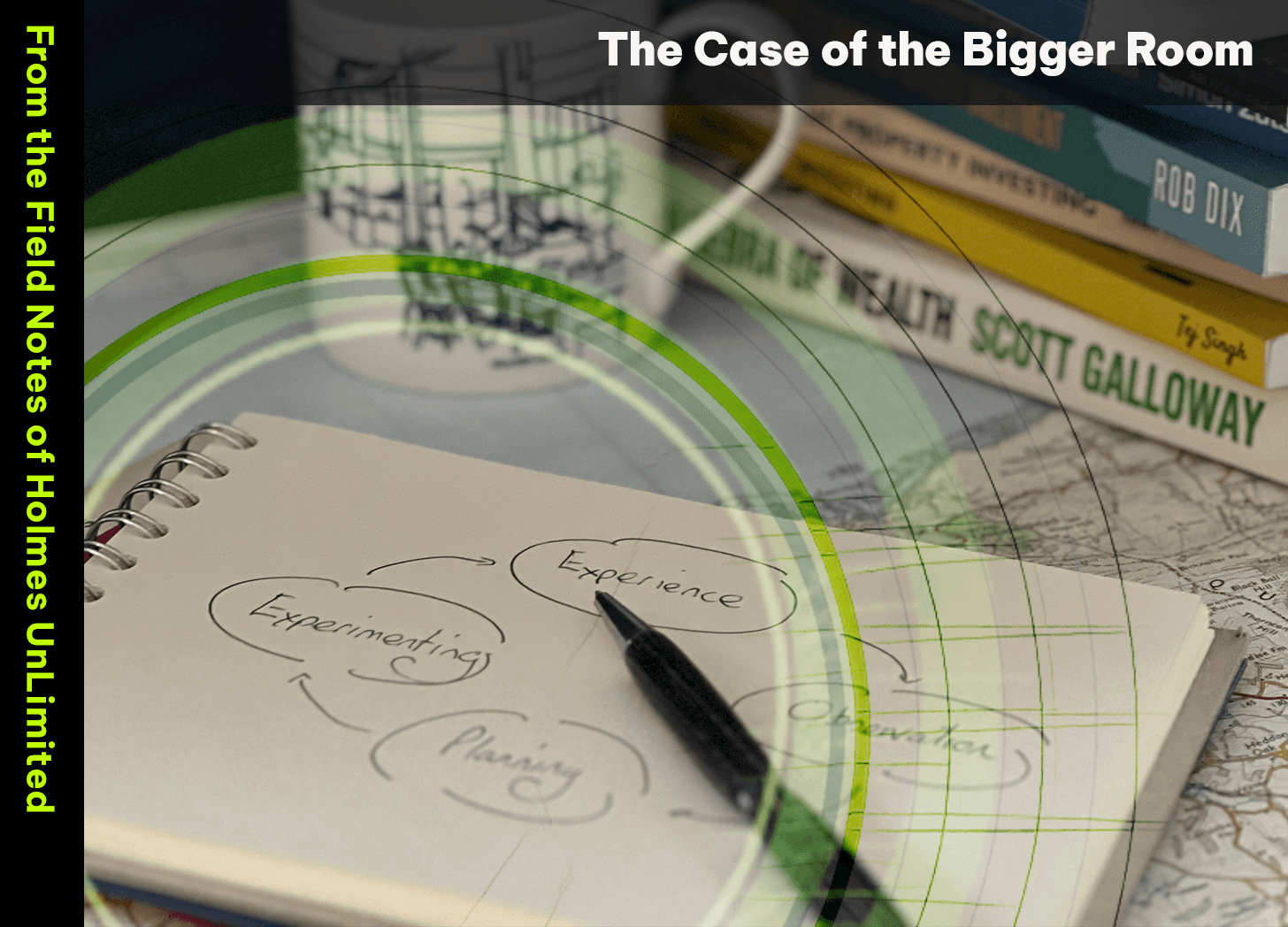
Something about the question felt too small for the room it was being asked in.
That was the first clue.
Vienna.
High above the city, the founder sat in an office of glass and steel. Winter light skimmed the windowpanes, tracing a thin silver line along their edges. Below him, the city stretched outward in ordered geometry: confident, vertical, modern. It was the kind of room that speaks of scale - height, horizon, ambition - long before ambition was named.
We met, as so many conversations now do, through a screen.
I sat in my own, more modest setting: my studio office in the Peak District. Bookshelves heavy with well-thumbed volumes. Journals stacked in uneven piles. A vision board pinned with ideas still finding their shape. Pens, notebooks, and creative tools scattered where they’d last been set down, waiting patiently for the next line of inquiry.
Two rooms. Two vantage points. One conversation.
Glass, steel, and ambition on one side of the screen. Paper, wood, and calm on the other. And yet, despite the distance - despite the contrast - we were meeting for the same reason: curiosity.
A shared desire to understand what might come next.
We’d already spoken once before. That first conversation had wandered easily — from work into family, from strategy into values. This second call was different. He wanted to return to a thread he’d left hanging.
His company sat at the intersection of live sound, performance, and technology. Innovative. Well regarded. Already successful. But he was looking beyond that. He spoke of Dolby - not simply as a firm, but as a standard. A name that carries meaning before the sound is even heard.
How, he asked, does a company earn that kind of recognition?
It was a great question. An ambitious one. The sort that gleams slightly when it’s first spoken.
At first, my mind walked the familiar paths: marketing; PR; strategic partnerships; brand architecture. All important. Yet all, somehow… insufficient.
Because the more I turned the question over, the less it felt like a branding problem. It felt… structural.
I pictured his business at the centre of a web: its systems, technologies, partners, and performers radiating outward, each strand influencing the next.
A brand of that scale isn’t made through messaging… it’s built from the depth and diversity of thinking behind it. So I asked him directly:
“Who leads on developing and shaping the strategy in your company?”
He paused - not out of confusion - out of recognition.
He explained that although there’s a C-suite of three - each highly competent, each leading a functional domain - as the Chief Executive, all the strategic thinking, the horizon scanning, the vision shaping… all of it ultimately lives in his mind.
That was the moment. The signal beneath the pattern. The clue that shifted the investigation.
Because a global ambition cannot be carried by a single cognitive engine.
A functional leadership team can run a company. But a world-scale vision asks for something else entirely. It asks for a wider room. A room filled with different perspectives, lived experience, challenge, and contradiction. People who have seen around corners you don’t yet know exist. People who recognise scale not as an abstraction, but as a felt reality.
World-leading strategy, I’ve learned, is rarely the product of solitary genius. It emerges from conversation. From friction. From the widening of viewpoint until the landscape comes fully into view.
I spoke then about advisory boards - not as governance, not as obligation - but as circles of trusted thinkers. People who stretch the horizon. Who question defaults. Who hold experience you don’t yet possess.
I watched the idea land: first as curiosity; then as something closer to relief. It was as though he could suddenly picture a larger room than the one he’d been working in. A space where the weight of the vision didn’t need to be carried alone. And the deduction, once revealed, was clear:
Big visions demand bigger conversations.
Small rooms can run companies. They can manage, execute, optimise. But only wide rooms - filled with challenge, diversity of thought, and experience - can build something that lasts beyond a single mind or moment.
I didn’t offer a conclusion. I rarely do. Instead, I left him with a question. The same one I’ll leave you with now.
Who is shaping the strategy in your work?
And is the room wide enough for the scale of what you’re trying to build?
If you’d like to linger… The Investigator’s Companion sits alongside this Field Note - a quiet place to pause, reflect, and follow whatever this story has stirred.
If this feels like something worth sharing…
You might share this with a fellow investigator - someone who enjoys comparing notes rather than collecting answers.
And if you’d like to stay close to the investigation…
You’re welcome to subscribe to Holmes UnLimited.
New Field Notes arrive from time to time - each an invitation to notice a little more clearly.
Clear the desk.
Quiet the noise.
And let the investigation continue…