Investigators Companion
The Curious Incident of the Impertinent Billboard - The Investigators Companion
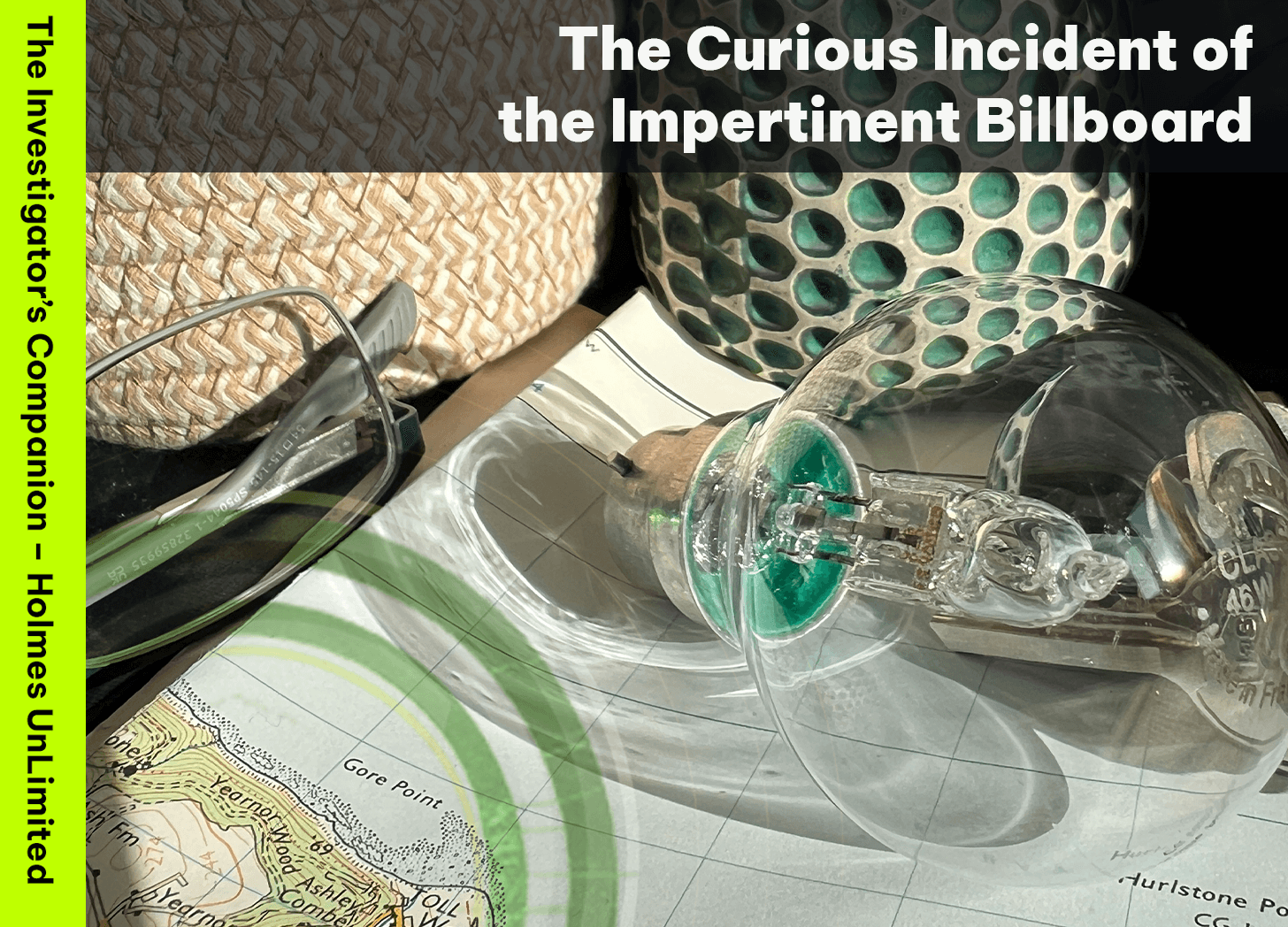
Small clues often reveal the biggest shifts.
This Investigator’s Companion sits alongside The Curious Incident of the Impertinent Billboard as a place to pause… not to solve, but to notice.
To follow what caught your attention. To explore what arrived when the search softened. To test small adjustments in how you notice the world around you.
It isn’t something you need to complete in one sitting. You may return whenever a clue reappears.
1. Follow the Clue
Every investigation begins with a detail that refuses to be ignored.
In this case, it appeared not in a strategy document or a case study… but on the gable end of a building, in bold white letters against a blue sky.
Clues rarely arrive where we expect them. They might appear as:
a sentence that seemed almost too simple
an unexpected flash of recognition
something you nearly overlooked while focused elsewhere
You don’t need to explain the clue yet… simply notice it.
If it helps, you might jot a few words in your Investigator’s Notebook (journal). Not to interpret, just to record.
What was the moment in the story that stayed with you?
2. Sit With the Question
In the story, the breakthrough didn’t arrive while searching harder - it arrived after the search had been exhausted, after the mind had stopped forcing the answer.
Rather than rushing to conclusions, allow the question to remain open for a while. You might ask yourself:
What question have I been trying too hard to answer?
Where might the clue already exist… but I haven’t yet noticed it?
What might become visible if I stopped searching and started observing?
Sometimes the most important insights appear not through effort, but through attunement.
3. Notice the Pattern
This story might not be about a billboard at all. It might be about the pattern many investigators recognise: searching intensely for an answer; eaching a point of frustration or exhaustion; releasing the search; and then suddenly… seeing the clue
You might look beyond this single moment and ask:
When has an answer appeared just after I stopped pushing for it?
Where in my work or life do I tend to force clarity instead of allowing it to emerge?
What signals might I be overlooking because they feel too obvious?
If a pattern begins to appear, simply name it.
Treat it as a working hypothesis, not a verdict.
4. Test a Small Shift
Rather than trying to solve everything immediately, consider a small experiment.
Something light. Something reversible.
For example:
stepping away from a problem for an hour or a day
walking or driving without actively trying to solve it
noticing what catches your attention when your mind relaxes
asking: what is already visible here that I’ve been overlooking?
Frame this not as productivity, but as inquiry.
What happens when you allow the answer to find you?
Whatever appears becomes evidence.
5. Compare Notes
Some clues reveal more when they are examined together.
If it feels useful, you might share this story - or simply the question it raised - with a colleague, peer group, or fellow investigator.
You might explore together:
what each person noticed first
how different people interpret the same clue
where insight appeared unexpectedly
Often, clarity sharpens when observations are compared.
For those who prefer inquiry over instruction, Holmes UnLimited unfolds through Field Notes, Observations, and Casebook investigations - each emerging as the casework develops.
Clear the desk.Quiet the noise.And let the investigation continue.
If this feels like something worth sharing…
You might share this with a fellow investigator - someone who enjoys comparing notes rather than collecting answers.
And if you’d like to stay close to the investigation…
You’re welcome to subscribe to Holmes UnLimited.
New Field Notes arrive from time to time - each an invitation to notice a little more clearly.
Clear the desk.
Quiet the noise.
And let the investigation continue…